Third-party tested · Vegan · Free US shipping over $75

NitrovibeNITROVIBE

Research

Creatine Is More Than a Gym Supplement. Science Is Showing Us Why.

Short, plain-language summaries of what the peer-reviewed research measured — including where the evidence is strong, and where it is still emerging. Every summary links to its source.

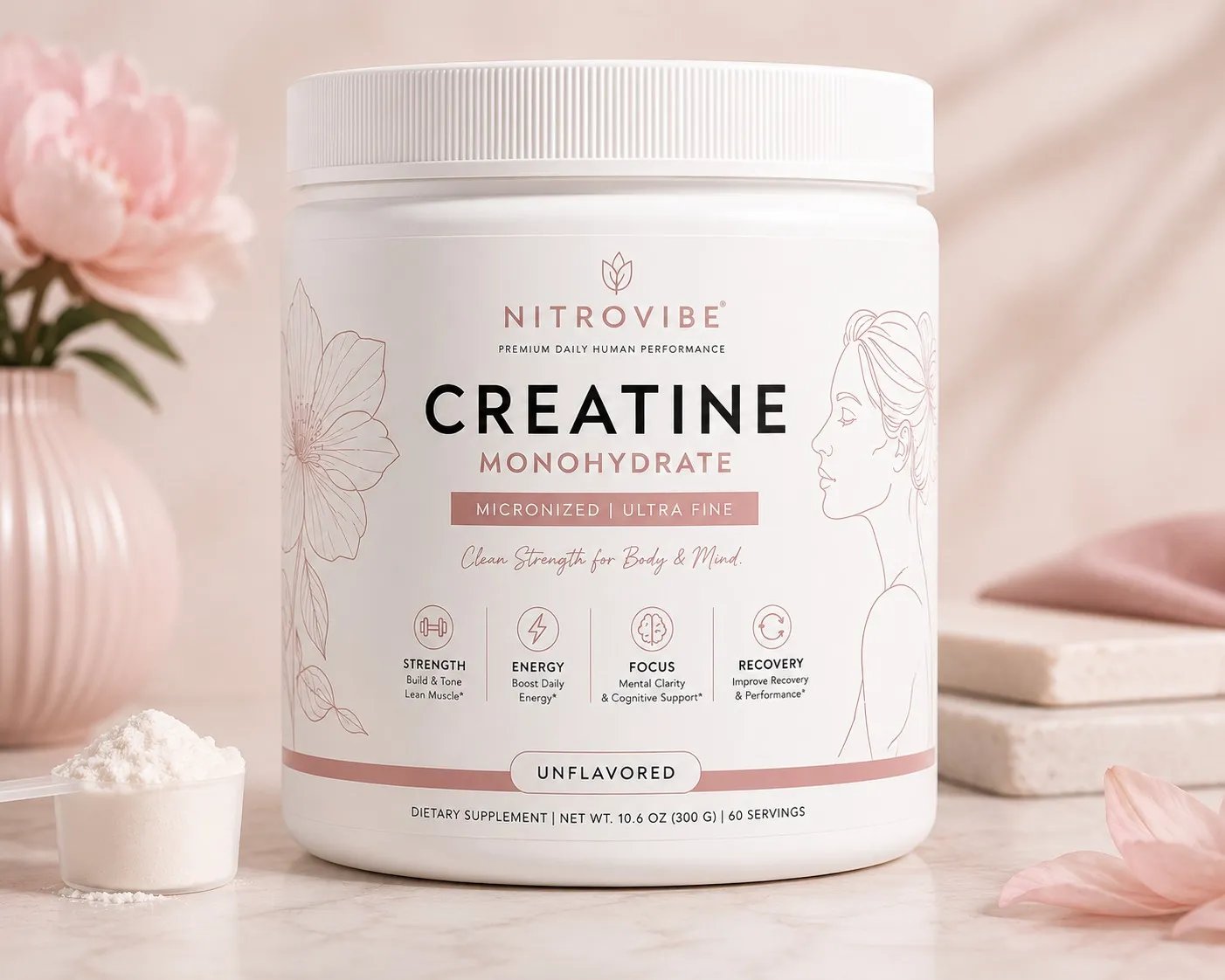
Nitrovibe micronized creatine monohydrate

Strength & lean mass

Meta-analysis of 12 studies, 2024 · adults under 50

Creatine + Resistance Training: More Lean Mass, According to a 2024 Meta-Analysis

A meta-analysis pooling 12 studies compared creatine supplementation combined with resistance training against resistance training alone.

In adults under 50, the creatine groups gained approximately 1.14 kg more lean body mass (95% CI 0.69 to 1.59) than the training-only groups, alongside a small reduction in body fat percentage. The effect is real but modest — creatine amplifies what training already does, it does not replace it.

Strength

Meta-analysis of 23 studies, 2024 · upper- and lower-body strength

Stronger Together: Creatine May Enhance Strength Gains From Resistance Training

A separate meta-analysis of 23 studies looked specifically at strength outcomes rather than body composition.

Compared with placebo, creatine combined with resistance training significantly increased upper-body strength (+4.43 kg) and lower-body strength (+11.35 kg) in adults under 50. The authors also note that in the small number of female-only studies included, the strength gains did not reach significance — one of the reasons the female evidence base still needs to grow.

More than muscle

Systematic reviews · brain creatine concentration

Creatine Isn’t Just About Muscle: Researchers Are Studying Its Role in the Brain

Creatine is not only stored in skeletal muscle — the brain uses it as part of its energy buffering system, which is why researchers have begun measuring brain creatine directly with magnetic resonance spectroscopy.

A systematic review confirms that supplementation can increase brain creatine content, with most controlled studies reporting rises in the region of 3% to 10%. Results on cognition as a whole remain equivocal, so the honest summary is: the mechanism is measurable, the cognitive outcomes are still being mapped.

Creatine & memory

Meta-analysis of 16 RCTs · 492 participants · memory: moderate certainty

Creatine & Memory: What a Meta-Analysis of 16 Clinical Trials Found

A meta-analysis of 16 randomized controlled trials with 492 participants pooled results across cognitive domains.

It found a significant positive effect on memory (SMD 0.31), plus favourable signals for attention time and processing speed. No significant improvement was found for overall cognitive function or executive function. The memory evidence was graded moderate certainty; the other domains were lower certainty, meaning future trials could still shift the picture.

Women & creatine

Systematic review, 2025 · 27 studies · physically active women

Women & Creatine: An Emerging Area of Science

Most of the historical creatine literature was conducted in men, which is exactly why this area matters to us.

A 2025 systematic review screened more than 10,000 records and included 27 studies in physically active females. Some benefits were reported — 3 of 11 strength/power studies, 4 of 17 anaerobic studies — but study quality varied and considerations specific to female physiology were poorly addressed in most trials. Emerging, not settled.

Healthy aging

Systematic reviews & meta-analyses · post-menopausal women

Creatine After Menopause: A Growing Field of Research

Systematic reviews and meta-analyses now look specifically at creatine in post-menopausal women, with lean mass, strength and bone density as the outcomes of interest.

Pooled results point to small but meaningful gains in lean mass and strength when at least 5 g a day is combined with resistance training; effects on bone density remain unclear, and adverse events were mild and comparable to placebo. In one 12-week trial in this population, the creatine group improved bench press by 14.3% versus 9.2% in the training-only group, and biceps curl by 22.3% versus 13.5% — the figures shown on our homepage.

These summaries describe published meta-analyses and systematic reviews on creatine monohydrate. They are educational only, are not medical advice, and are not intended to diagnose, treat, cure or prevent any disease. Creatine is not a treatment for any condition and individual results vary. Speak with your healthcare provider before starting any supplement.

Research | My Store